AI Use Cases for Indian Real Estate Developers, Ranked
Where does AI pay back first for an Indian developer?
AI pays back first before land is bought and before plans are frozen: in site test fits, comparing design options, and evaluating basement and parking layouts. Getting these decisions wrong can cost developers weeks of work or crores in project value. A faster, more reliable answer can change what gets bought or built. Sales, marketing and administrative gains are real, but typically smaller.
Over the past four months, I've spoken with strategy, design and feasibility teams at developers in Bangalore, Chennai, Mumbai and Delhi NCR. Almost all of them had been told to "use AI". Very few knew where to start. This post looks at the use cases I've heard about across different teams and ranks them by how quickly they deliver a return on the time and money invested.
The aim is to help you decide whether and where to invest in AI training and change management to maximise its benefits.
How should you rank AI use cases?
Evaluate each use case against four questions. A use case that scores well across all four is a strong candidate for your first pilot.
What does it cost today? Are we talking about days of work or crores in potential project value? If a task already takes an hour, reducing it to ten minutes is unlikely to register on any metric leadership tracks.
Does a faster answer change a decision? Screening more sites before you bid, or taking more options into a design review, can change what gets bought and built. Faster paperwork rarely does.
Do you already have the inputs? Site boundaries, development regulations, unit sizes, parking requirements and, most importantly, buyer insights already sit within your organisation. How can you leverage these to improve project value and accelerate sales cycles?
Is the output quick to verify? An output generated in ten seconds saves nothing if someone then spends two days checking it. AI only pays back when the time spent reviewing and validating the output comes down too.
The last question is where many AI implementations struggle, particularly in design workflows.
Which AI use cases pay back first, team by team?
The table below ranks the use cases based on conversations with developers, from fastest to slowest payback. The costs reflect how individual developers described and quantified the problems that led them to explore AI solutions. Use them as reference points to assess the intensity of similar problems within your own organisation and where addressing them could deliver your team the greatest return.
Rank | Team | Use case | What it costs today | Payback |
1 | Land acquisition strategy | Site test fits before a bid | 3–4 days per site, about 60–70 lakh a year in architect time | Weeks |
2 | Design management | Generating and comparing design options | 2–3 days per review round, plus architect fees for every additional option requested | Weeks |
3 | Site design | Masterplanning, Block and unit strategy, Basement parking layouts | Lost sales and longer sales cycles from poorly designed projects; expensive retrofits and marketing; crores in potential revenue from additional parking in luxury projects; months added to construction timelines by poorly planned basements | One project |
4 | Regulations and compliance | Identifying the rules that apply to a new site | A critical first step that developers identified as one of their biggest feasibility bottlenecks | Days, if the tool understands your cities and their various jursidictions |
5 | Project management | Tracking consultant drawings and chasing late submissions | Missed milestones on live projects | Months; incremental gains |
6 | Sales and marketing | Brochure copy, visuals, lead follow-up | Agency costs and internal team hours | Fast, but rarely a board-level number |
7 | Product strategy and sales | Predicting which unit mix and plans will sell | Unsold towers, price cuts, and in one case, a rebuilt tower | Years; easier to identify a poor outcome than to measure the impact of a better prediction |
The top four have something in common: they influence decisions made before land is bought or plans are frozen. A faster, more reliable answer can change what gets bought, designed or built. Ranks 5 and 6 save time and effort, but rarely change a major business decision. Rank 7 has potentially the biggest prize, but also the longest road to realising it.
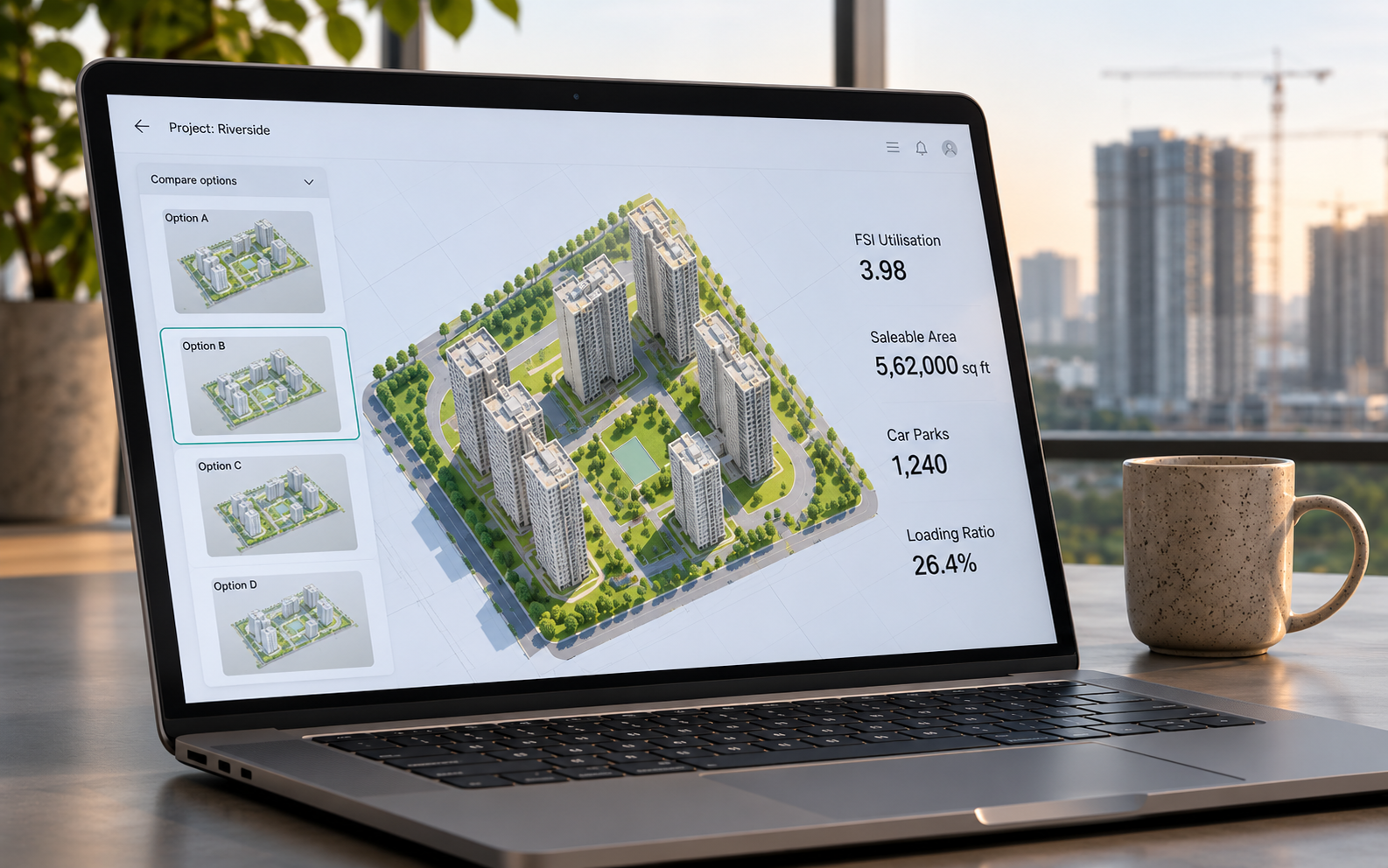
Habitable is built for ranks 1 to 4. It gives strategy and design teams a go/no-go on a site across product mixes, and evaluates hundreds of compliant master plans with parking built in. Teams can compare options on cost, loading ratios, facade area and RERA carpet area.
Book a demo, and we'll run it on a site you're evaluating now.
Why do strategy, feasibility and design teams see the fastest payback?
These teams decide what a site is worth and what gets built on it. When AI is combined with spatial intelligence, it can help teams evaluate more possibilities, uncover constraints earlier and make better development decisions.
Land acquisition and site test fits. The strategy head at one developer told me his team screens about 25 sites a month across multiple cities. Each test fit takes internal architects 3–4 days. Since this isn't their primary responsibility, the work often gets pushed behind live projects. He estimates that automating test fits could save ₹60–70 lakh a year in architect time. But the bigger opportunity comes after the test fit: due diligence takes 3–4 months, and the team only initiates it if the test fit works. A faster, more reliable test fit means fewer months spent evaluating sites that were never going to work.
For developers buying land at market rates, with no land bank to fall back on, feasibility is directly linked to the P&L. One national developer keeps the process entirely in-house for this reason. Its team takes 2–4 weeks to move from initial site assessment to an internal presentation where the acquisition decision is made.
Feasibility automation is already changing the baseline. At another developer, an in-house team had built Revit-based tools that brought feasibility turnaround down to about a day. Over six months, they explored 200–300 layout options across roughly 50 sites. Faster layouts were no longer a major bottleneck for this team. The next opportunity was to bring more information into the initial assessment, particularly parking requirements. A layout that looks viable at the site level can become infeasible once the parking strategy is factored in. The value of drawing automation isn't simply producing drawings faster. It's bringing multiple dimensionally and geometrically verified data points together to make better decisions about what can actually be built.
Comparing design options. The design-management lead at a luxury developer said a round of design options takes his team 2–3 days just to review the strategy, metrics and ratios. External architects charge for every additional option, which means that on fast-moving projects, fewer alternatives get explored. He doesn't necessarily need AI to design for him. He wants it to generate options and compare them against the hundreds of metrics his team already tracks: saleable-to-built-up area, wall-to-floor ratios, facade area and cost, and propose the best optimised ones.
Finding the rules. A Chennai-based development team told me the slowest part of feasibility is working out which regulations apply to a new site. Without the right regulatory inputs, automation can create infinite options, but few will make practical sense. Another team pointed out that in some high density cities like Mumbai, the product and development potential can change dramatically even between nearby locations, as land economics, regulations and permissible FSI change.
For teams operating across multiple cities, the challenge is even greater. At one large developer, internal design automation is part of a five-year technology roadmap. The challenge is building something that works across different regions, where development regulations, parking requirements, approval processes and even design priorities vary. A useful system would need to account for inputs from business, structural, MEP and operations teams, not just architects. The developer described the work as a process of learning and unlearning, requiring significant investment and budget realignment. While the direction has been chosen, the implementation is still being worked out. This is an indication of the scale and complexity of the underlying transformation.
Basement parking. In some luxury developments, 10 additional parking spaces can be worth up to ₹1 crore, particularly when combined with private garage strategies. Ground-plane planning is critical for premium developments, and each additional basement level can add around six months to the construction timeline. Getting the parking count, ramp configuration and basement design right early can therefore deliver significant returns within a single project.
There is a common warning across these use cases: most AI tools are built around generic sites and generic regulatory assumptions. One design head told me that 90% of the tools he'd tried failed to meet regulatory compliance requirements. I tested this myself on a tapered Bengaluru plot. While AI got the maths and approximate room sizes right, it often struggled to understand the nuances that make or break residential design and broke the brief.
Habitable is built for India
A general-purpose chatbot doesn't know your city's bylaws. It doesn't understand how Indian space planning is shaped by Vastu, or how its importance and interpretation vary across cities and buyer segments. It doesn't understand how room-size expectations differ across markets. For instance, a generic tool won't inherently know that Indian buyers expect 12’ x 20’ bedrooms. This is the gap Habitable fills. Habitable is built around India's development regulations and residential design requirements, so every option it generates is designed to meet the applicable constraints, while allowing your team to override individual design decisions.
Book a demo to see it test-fit a site against your own standardsPredicting which plans will sell is the biggest prize. A development advisor who has worked with several developers said the gap between design decisions and pricing is one of the main reasons inventory moves slowly. Increasing unit area doesn't automatically increase the price a buyer is willing to pay. A 420 sq ft 1BHK might sell well, and a 450 sq ft one might too, but only if the additional area gives the buyer something worth paying for. He also described a case where a tower had to be demolished and rebuilt after its 4BHK units failed to sell. In his experience, most developers determine their unit mix through instinct and an understanding of their buyer personas. Very few are able to pre-validate those decisions against concrete sales data before committing to a design, so it remains partly a gamble.
Many developers already have relevant data in their CRMs and sales records. The potential payoff from using it to predict the parameters that cause units to sell well is substantial. But measuring the impact is difficult: if a better-performing unit mix improves sales, how much of that improvement came from the prediction itself, and how much from changing market conditions? That's why this ranks seventh. AI can help teams organise and analyse years of plans, unit configurations and sales data, but establishing a reliable link between design decisions and sales outcomes is a much longer-term challenge.
What about real estate sales and marketing teams?
AI tools in sales and marketing deliver quick, visible wins, but rarely move the top-line numbers that boards care about. The bigger opportunity is helping buyers make purchase decisions faster, and eventually predicting what will sell. The latter, however, takes years.
Marketing content pays back fast, but the gains are small. Brochure copy, social posts, renders and lead follow-ups are where most teams start, and these applications work. But the savings are typically measured in agency costs and internal team hours, rather than crores in project value.
Helping buyers picture the home can have a more direct impact on sales. Buyers often struggle to interpret floor plans and visualise what a finished home will look like. If they can't understand the space they're buying, it becomes harder to make a confident purchase decision.
An interiors lead at one developer told me that creating updated visualisations with revised kitchen finishes helped accelerate unit absorption. At another developer, around 100 additional units were sold once the sample flat was completed. Anything that helps buyers understand a home more clearly, earlier in the sales cycle, is worth testing.
Where doesn't AI pay back yet?
Full design coordination and managing construction on site are two areas where I heard the least evidence of immediate payback.
This doesn't mean teams aren't automating design coordination and documentation. There is a growing range of tools targeting architects that promise to automate working drawings, shortening the delay between design completion and the start of construction. But the architects I spoke with were cautious about trusting these outputs. An error in a construction drawing can translate into crores in rework, delays or liability on site. The cost of getting it wrong is simply too high to rely on unverified AI-generated documentation.
It also depends on how well your team manages project information today. Simply implementing BIM isn't enough. AI tools need clean, structured and coordinated project data to work reliably, which in turn depends on good BIM practices. One developer's team found that despite having implemented BIM, around 80% of the issues identified on site weren't captured in their drawings. They pointed out that on their previous project, a 50-storey tower, MEP issues were still largely being resolved on site, despite detailed coordination on BIM. The gap between what is documented and what actually happens during construction remains significant in practice.
AI tools will likely become more capable of addressing some of these challenges. We're already seeing tools emerge in this space. Roger, for instance, uses AI to support constructability reviews, identify design errors and omissions, and flag inconsistencies between drawings and specifications. InspectMind AI is another example, helping teams automate drawing reviews, specification checks and code compliance reviews. These tools are beginning to address the gap between design documentation and construction readiness, although their outputs still need professional review.
None of this means "never". It means starting with the use cases where your team already has the inputs, can verify the output quickly, and where a faster answer changes a business decision. This 30-day pilot plan shows how to run that first test and take it to leadership.
Not sure where your team should start? In a 20-minute demo, we'll go through your feasibility workflow, show where it loses days, and run Habitable on one of your past projects so you can compare it with what your team delivered.
Book a demo with our team here →
FAQ
What are the best AI use cases for real estate developers in India? Site test fits, comparing design options and basement parking layouts. They cost days or crores today, and a faster answer changes what gets bought or built.
What is the ROI of AI for a real estate developer? It depends on the use case. One developer estimated ₹60–70 lakh a year in architect time from automated test fits. In luxury projects, 10 extra cars in the same basement is worth about ₹1 crore.
Which team should adopt AI first? The strategy, feasibility or design team that makes decisions before land is bought or plans are frozen. Their work has the most direct effect on the P&L.
Can AI predict which apartments will sell? In principle, yes, using RERA data and your own sales history. In practice most developers don't yet record their plans and sales data in a form a model can use. Start by collecting it.
Why do AI tools struggle on Indian projects? Most are built for rectangular sites and generic codes. Indian projects need city bylaws on top of the NBC, Vastu rules, local room sizes and parking norms.
Can AI replace architects at a developer? Not today. It's useful for checking work, comparing options and running the numbers. Deciding the best design for a site still needs an experienced architect.
What does Habitable do? Habitable is an AI design layer for strategy and design teams at Indian developers. It gives a fast go/no-go on a site, evaluates hundreds of compliant master plans with parking, and compares Vastu-compliant options on cost, loading ratios and facade area.